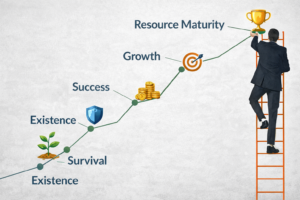
Cash flow is the lifeblood of any business. It is what dictates whether a company can keep its operations going smoothly, pay employees on time and invest in future growth. Many companies – and successful ones, at that -fail because they lack cash, not because they run out of good ideas. Which is why learning how to Forecast cash flow effectively is a foundational skill for any business owner, manager or financial head of department.
A good forecast is the foundation of any business plan that lets founders and leaders get a grip on what the future might hold. By forecasting inflows and outflows with Accuracy, businesses can avoid surprises, time their investments for maximum impact and steer through uncertainty with confidence.
This hands-on guide cuts through theory and marketing to help business leaders develop a robust, no-nonsense approach to demand forecasting that focuses on the nuances of their unique operations as well as market conditions.
The Importance of Cash Flow Forecasting Today More Than Ever
Today’s businesses work in linearly unpredictable environments, fiercely competitive markets, fluctuating costs, supply chain interruptions and ever-changing customer preferences. Forecasting lets you be offensive rather than scrambling at the last minute.
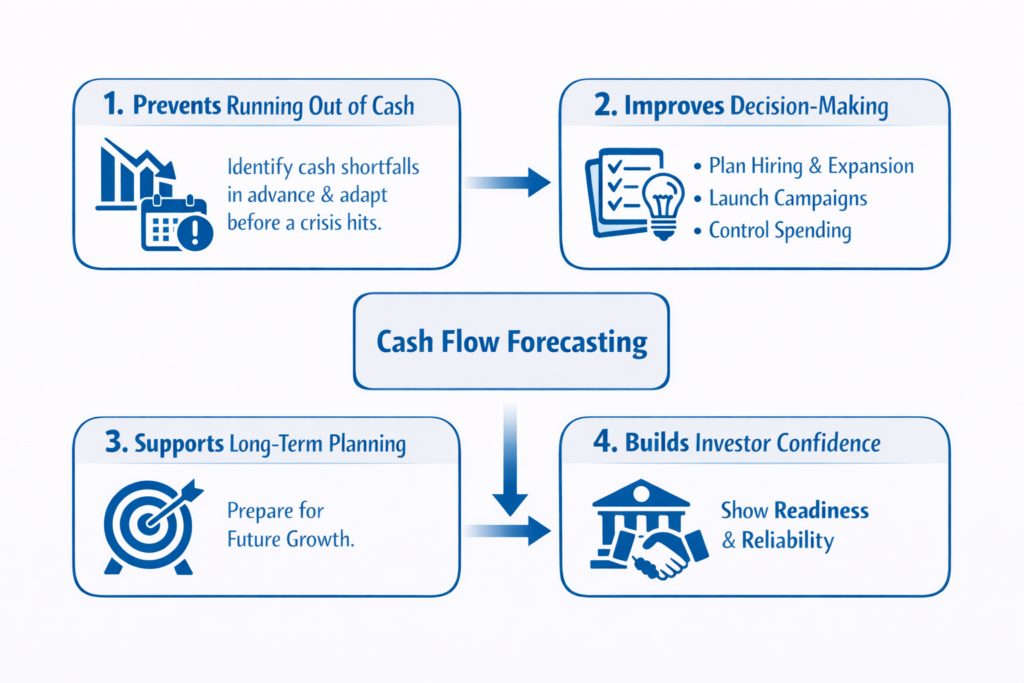
1.Keeps You From Running Out of Money Before It Runs Out
There will be cash flow forecasting that highlights upcoming low points in the near future, based on customer payments, expenditure and seasonality. By identifying a shortfall weeks or months in advance, you may be able to adapt your facility before the crisis strikes.
2.Improves Decision-Making Quality
Forecasting gives clarity. You can plan when to:
- Hire new employees
- Expand operations
- Launch campaigns
- Buy inventory
- Reduce spending
- Every decision becomes more strategic
.
3.Strengthens Long-Term Planning
But whether you intend to open a new location, invest in technology or scale your team, forecasts provide you with an honest view of what the business can afford.
4.Builds Investor and Lender Confidence
Banks and investors will want to see that you know your numbers. A robust cash flow projection indicates readiness, accountability, and fiscal responsibility.
Best Practices in Cash Flow Forecasting
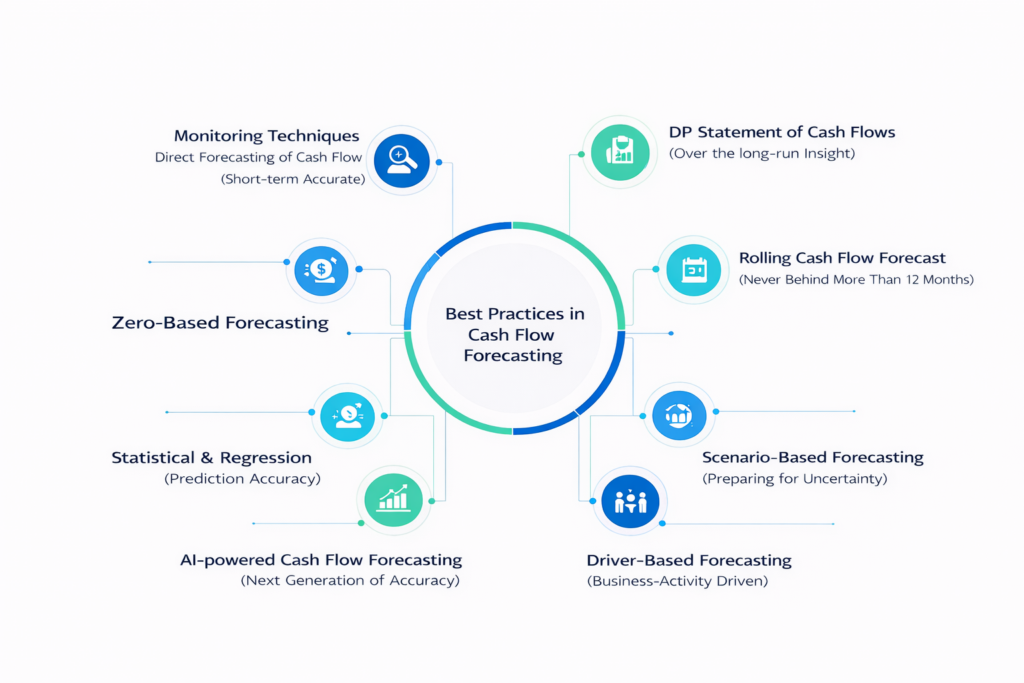
Here are the most popular budgeting methods supported by CFOs, founders and financial planners around the globe.
1. Monitoring Techniques for the Direct Forecasting of Cash Flow (Short-term Accurate)
Purpose:
Weekly or monthly forecast. How it works: It tracks actual expected transactions — sales receipts, bills, rent, salary and supplier payments, etc.
Best for:
Small business owners, retail and restaurant stores and seasonal businesses.
Example:
A boutique store forecasts weekly sales and supplier payments by direct forecasting. By observing a dip in advance, they hold off for a week on restocking and don’t run out of cash.
2.DP Statement of Cash Flows (Over the long-run insight)
Purpose:
High-level 6–12 month view. How it works: Begins with net profit, adds back non-cash charges such as depreciation and then adjusts for working capital movements.
Best for:
Investors, business plans and long-term strategic decisions.
Example:
A software, as a service business, getting ready for venture capital, uses indirect forecasting to calculate its 12-month runway. This enables them to raise money when it’s appropriate and not desperate.
3.Rolling Cash Flow Forecast (Never Behind More Than 12 Months)
Purpose:
Ongoing forecasting. How it works: The day the month ends, a new month is added — no more, no less 12 months’ worth of outlook at all times.
Best for:
Increased Accuracy, ability to respond to market changes, and prevents surprises.
Example:
A logistics company revises its monthly forecasts based on fuel costs. And it shields them from spikes in costs and helps to preserve their profit margins.
4.Zero-Based Forecasting (Powerful Cost Control)
Purpose:
Reviewing expenses from bottom up. How it works: No expense is sacrosanct; each must be defended to the ground.
Best for:
Startups looking to cut burn, restructuring companies.
Example:
A startup audits everything, SaaS tool, licenses and services.) By discarding all except the most essential, they save over ₹2,75,000 a year.
5.Scenario-Based Forecasting (Preparing for Uncertainty)
Purpose:
Plan for multiple futures. How it works: Develop three models — best case, worst case and realistic.
Best for:
Seasonal firms, volatile markets.
Example:
An e-commerce brand creates three holiday season predictions. By setting inventory and marketing budgets for each scenario, they mitigate both out-of-stocks and overspending.
6.Driver-Based Forecasting (Business-Activity Driven)
Purpose:
Tie forecasts to actual operational drivers. How it’s done: Forecast revenue and expenses according to measurable inputs… sales volume, footfall, pricing strategies, marketing leads.
Best for:
Retail, hospitality, salons, and manufacturing.
Example:
A salon group forecasts sales using average footfall × service price. It allows them to schedule staff properly and not overstaff on slow days.
7.Statistical & Regression Prediction Accuracy (From Data)
Purpose:
To forecast tomorrow, what will happen today, but it was yesterday’s tomorrow. Techniques: moving average, ARIMA, regression analysis, time series modeling
Best for:
Companies with reliable historical data.
Example:
A gym is using trends from 3 years of membership to forecast monthly cash inflows and budget marketing spend.
8.AI-powered Cash Flow Forecasting (Next generation of Accuracy)
Purpose:
Utilize machine learning to enhance the Accuracy of forecasting Tools: QuickBooks, Zoho Books, Xero Analytics, Float, and Power BI ML model example.
Example:
Real-time predictions, automatic alerts, anomaly identification, improved Accuracy.
Actual Case Examples Demonstrating the Use of Cash Flow Forecasting
Real Case: Walmart Adopted Rolling Cash Flow Forecasts for Better Predictability
As reported by CFO.com, Walmart replaced traditional annual budgets with rolling 12-month forecasts, allowing the company to respond faster to supply chain changes and protect its cash flow during volatile periods.
Real Case: Airbnb Used Zero-Based Forecasting to Control Burn
In a 2020 CEO letter, Airbnb confirmed that it rebuilt its entire budget from scratch — a classic zero-based approach.
This cost discipline protected cash reserves during the pandemic, helping Airbnb survive a 90% collapse in business.
Real Case: Netflix Uses AI for Subscription & Content Cash Flow Predictions
Netflix’s tech blog details how they use machine-learning models to forecast subscriber growth and viewing demand.
These forecasts guide billion-dollar investment decisions in content production and protect the company’s cash flow.
How Touchdown Strategy Enhances Your Financial Forecasting
Touchdown Strategy is helping other entrepreneurs through simple, actionable, and data-driven financial models. Services include:
- Custom cash flow forecasting templates
- Complete financial plan for a business plan
- CFO-level strategic advisory
- Scenario-based and driver-based forecasting models
- Cash optimization and profit-improvement plans
- Rolling forecasts (daily, weekly, monthly or quarterly)
The aim is to provide business owners with clarity, confidence and a clear road map for sustainable growth.
Website: www.touchdownstrategy.com
Conclusion
Learning how to forecast cash flow isn’t just a finance exercise — it’s an issue of survival and growth. By giving you an accurate forecast, it allows our clients to have a better view of their current cash and contact situations for the future. And whether you’re forecasting your finances for that business plan or preparing for next quarter, it’s the key to resilience, profitability and staying ahead of the competition.
Companies that forecast well don’t merely survive. They scale with confidence.