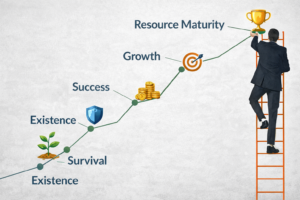
Doing business today is nothing like it was even five years ago. Customers expect faster responses, teams hope for smoother workflows, and the competition moves faster than ever. In such a landscape, relying solely on manual work or outdated processes impedes growth and increases costs. It is for this reason that businesses, big and small, are embracing a robust business process automation strategy to ensure every part of their operation is running at maximum efficiency.
Automation is much more than simply applying “shiny” tools. It is about reimagining how your business operates—eliminating unnecessary steps, avoiding repetitive errors, and building a system designed to scale. When done right, automation is the fuel that propels a business forward.
Why Growth Requires Automation
The majority of businesses don’t fail due to poor products or a lack of customers. They fail due to sluggish procedures, manual labor bottlenecks, and operational stalls. McKinsey & Company found that 60% of all business tasks are automatable—and those who successfully implement automation report a 20–30% enhancement in performance.
Automation enables more time, less work, and higher productivity. Rather than dedicating hours to repetitive activities—such as invoicing, scheduling, reporting, inventory updates, and customer follow-ups—leaders can focus on strategy and growth.
For example, a medium-scale retailer in Bangalore automated its billing, inventory updates, and CRM. Within six months, they saw:
- 42% faster order processing.
- 27% reduction in inventory errors.
- Significant reduction in overhead costs. In the owner’s words, “We didn’t need more people; we needed better systems.”
How an Automation Strategy Transforms Your Company
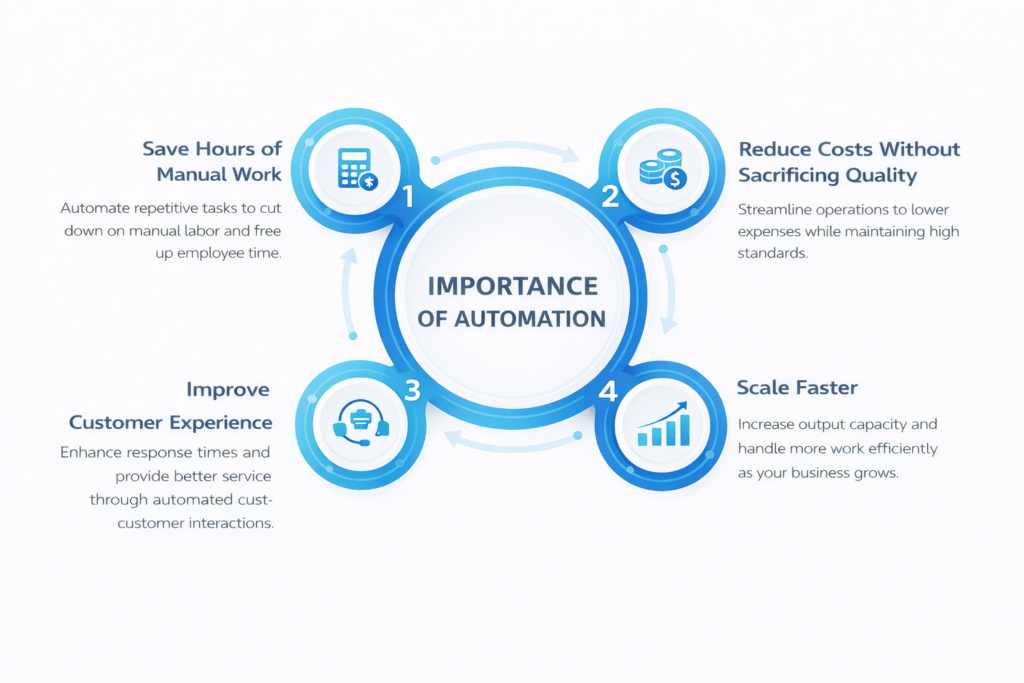
A professional automation strategy changes the way your company does business day-to-day.
1. Save Hours of Manual Work
Most businesses are unaware of how much time employees spend on simple, repetitive tasks. According to Deloitte research, workers dedicate 20% of the workweek to repetitive tasks, including manual data entry. Automation cuts this time dramatically.
2. Reduce Costs Without Sacrificing Quality
When there are fewer manual processes, there is less expense related to human error, rework, paperwork, and delays. Businesses typically save between 25% and 45% in the first year of applying automation.
3. Improve Customer Experience
Customers receive updates, responses, and reminders automatically. By reducing response times and minimizing errors, you build trust and reliability, leading to higher sales and retention.
4. Scale Faster
Automation helps you handle a higher volume of work without proportional increases in staff. A business that once required 10 people to operate can often function more efficiently with 6 or 7 once its procedures are automated.
Real-World Case Studies
Case Study 1: Domino’s
Domino’s built one of the world’s most automated ordering systems, using digital ordering, automated pizza tracking, and AI-driven routing.
- Impact: Digital orders rose above 75%, and revenue in automated markets increased by over 30%.
Case Study 2: American Express
American Express adopted AI-based workflow automation for customer service and fraud detection.
- Impact: Achieved a 30% increase in customer-service productivity and significantly faster response times.
Case Study 3: Unilever
Unilever implemented Robotic Process Automation (RPA) in its global finance operations.
- Impact: Saved over 30,000 work hours per year and improved the speed of financial reporting.
5 Steps to Implement Your Automation Strategy
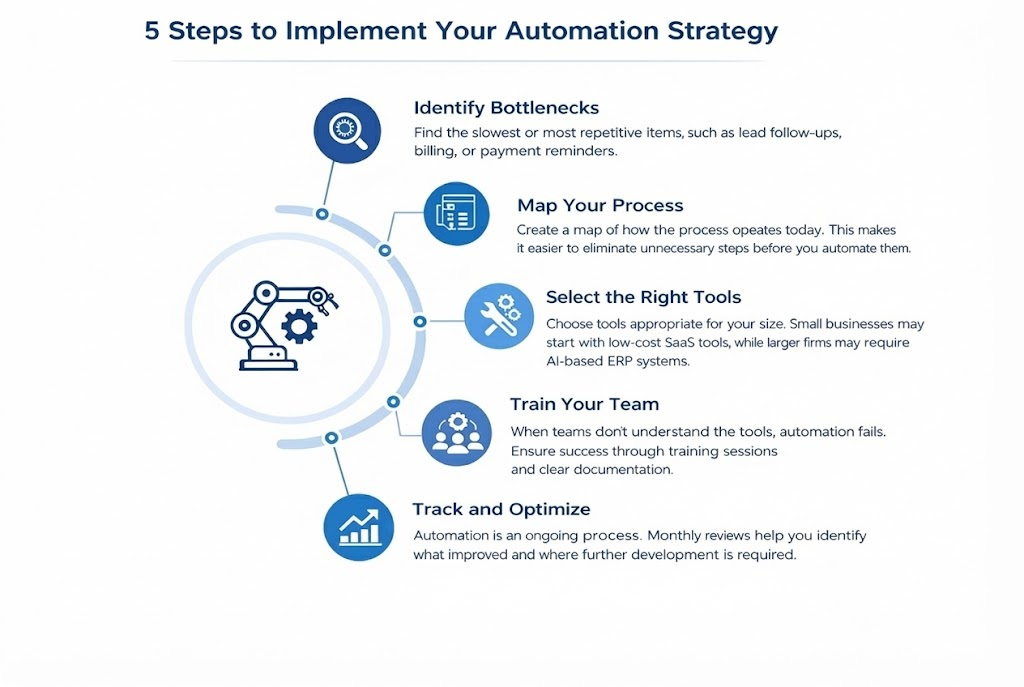
- Identify Bottlenecks: Find the slowest or most repetitive items, such as lead follow-ups, billing, or payment reminders.
- Map Your Process: Create a map of how the process operates today. This makes it easier to eliminate unnecessary steps before you automate them.
- Select the Right Tools: Choose tools appropriate for your size. Small businesses may start with low-cost SaaS tools, while larger firms may require AI-based ERP systems.
- Train Your Team: When teams don’t understand the tools, automation fails. Ensure success through training sessions and clear documentation.
- Track and Optimize: Automation is an ongoing process. Monthly reviews help you identify what improved and where further development is required.
How Touchdown Strategy Can Help You Scale
Touchdown Strategy is an expert in automating and digitizing businesses to drive peak performance. Rather than providing generic tools, we create tailored business process automation solutions focused on your specific workflow, industry, and growth goals.
We help businesses:
- Audit workflows to identify where the most time and money can be saved.
- Leverage CRM and AI-based automation to streamline operations.
- Simplify sales, financials, and customer service processes.
- Slash manual labor costs and improve overall profitability.
- Train teams to operate automated systems with confidence.
Clients of Touchdown Strategy see accelerated implementation, fewer mistakes, and a healthier bottom line. Visit touchdownstrategy.com to learn more.
Conclusion
A well-thought-out business process automation strategy is a necessity, not an afterthought. Companies using automation grow faster, spend less, and operate more efficiently. Whether you are a lean startup or an established enterprise, automation provides the platform to operate smarter.
The future belongs to businesses that create systems, not just teams. Automation helps you do both.