Running a small business can be exciting.But it can also sometimes make you feel like an ant on top of a log in the middle of the Pacific Ocean. You’re so small, and the ocean is so vast. It doesn’t help when there are giant companies that seem to have limitless resources and people. Many small business owners pose this question: “How in the world do I stand out when big brands are already ruling the roost?”
The fact is, you don’t need a ton of money or a giant staff to win. What you want is a small business strategy you can understand and execute without needing to make costly mistakes along the way.
Small businesses have something incredible that big brands do not: speed, personal connections and flexibility. When you leverage those strengths the right way, you don’t just survive – you thrive.
Let’s examine how small businesses can craft a savvy strategy that will work in the real world.
Why Strategy Is Even More Important for Small Businesses
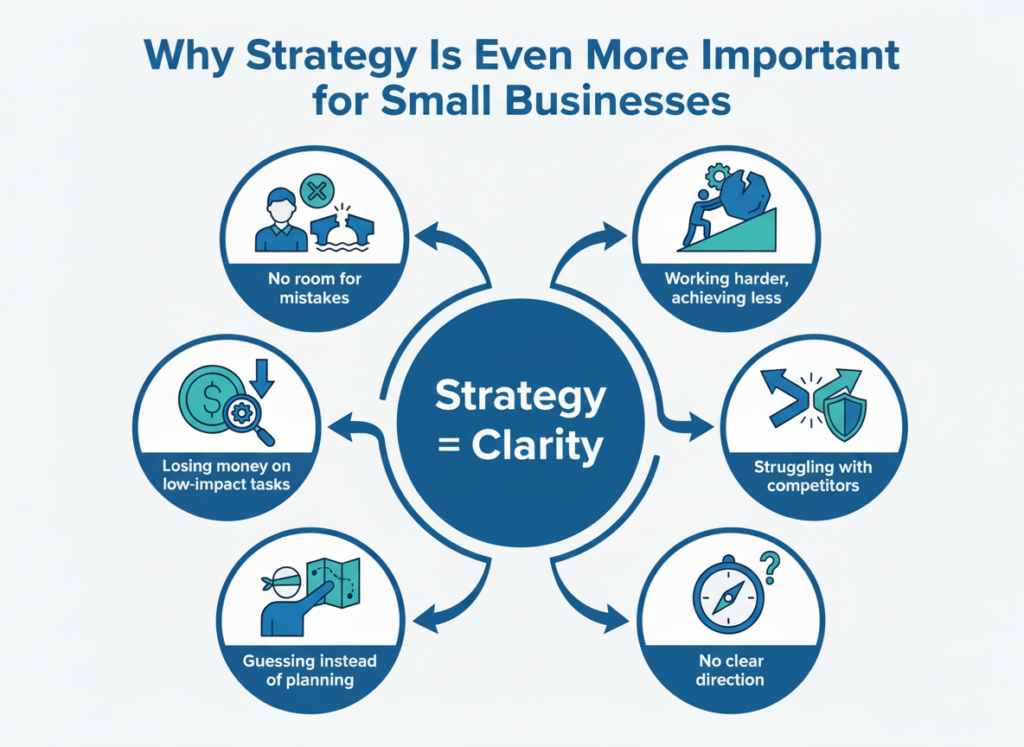
The bigger mistake people make is to think only big businesses need a strategy. But the opposite is true. Small businesses need a strategy even more, as they don’t have money for mistakes.
If you don’t have a plan, then you are left with:
- Working harder but achieving less
- Battling to keep pace with rivals
- Operating without clear direction
- Guessing as opposed to Planning
- Losing money on non-forward-moving tasks
A good strategy does not complicate your life; it simplifies your life. It turns chaos into clarity.
The New Business Reality: Why Small Businesses Must Evolve
Now, as customers’ own standards get higher and more companies begin acting like tech companies, customers want faster delivery of goods and services, digital convenience, transparency and experiences that feel tailored to their tastes. Technology is changing every industry. New competitors appear almost overnight.
In such a setting, small businesses can no longer rely on outdated processes, or “the way things always worked.” For small businesses to remain competitive, they need to:
- Use modern tools
- Offer better experiences
- Deliver faster
- Create strong systems
- Understand what customers really want
The good news? These are all things at which a small business can be extremely good.
Strategies That Help Small Businesses Compete With Big Brands
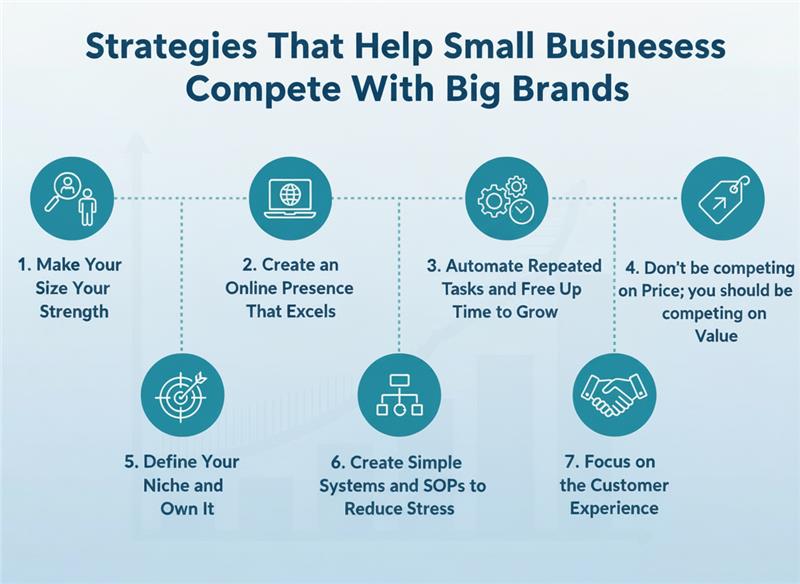
These are practical, sane things any small business can do to create that base of loyal people.
Make Your Size Your Strength.
Established small business owners often view their size as a liability. But in fact, it’s your greatest power.
Small teams can:
- Understand customers personally
- Make decisions quickly
- Adapt faster
- Offer customised service
- Build real relationships
A large, primed ordinary person can’t know your name or customize its services to you. A small business can. PwC found that 73% of consumers say customer experience is their biggest buying factor — and small businesses naturally deliver more personal, human service.Leverage this strength — it’s what brings customers back time after time.
Create an Online Presence That Excels (And Is Easier Than You Think)
You don’t have to spend a massive advertising budget just to be seen online. You do just need regularity and clarity.
Start with:
- A simple, modern website
- A complete Google Business Profile
- Honest customer reviews
- Helpful social media content
- Educational and trust-building blogs
Google reports that 76% of people who search for something nearby visit a business within a day — and many of those visits lead to purchases.
Automate Repeated Tasks and Free Up Time to Grow
The majority of small businesses are stuck doing things like:
- Sending reminders
- Updating spreadsheets
- Following up with leads
- Managing appointments
- Repeating the same messages
And these can all be done for you with the use of automation tools.” This means:
- Less manual work
- Fewer mistakes
- Faster service
- More time for meaningful work
Automation enables you to run a bigger, more professional business without the need for a big team.
Don’t be competing on Price; you should be competing on Value.
Most small businesses compete for customers by reducing prices. But low prices bring out challenging customers and compress profits.
Instead, try providing more Value:
- Faster service
- More accurate work
- Friendlier communication
- Customised experience
- Bonus services or guides
When people feel taken care of, they are willing to spend a little extra.
Define Your Niche and Own It
The more one tries to sell to everyone at once, the more likely it is that no one will buy. Small businesses that niche grow faster.
Examples:
One bakery, one specialty pastry
A hair colouring specialist salon,” I was treated to highlights from the Glory Days Collection by TIGI.
Small business growth consultant
Beginner’s Fitness Coach
Niche businesses enjoy better identity, customer loyalty and margin of profits.
Create Simple Systems and SOPs to Reduce Stress
Even a small business gets better when processes are transparent.
Document how you:
- Respond to inquiries
- Onboard customers
- Deliver products
- Handle complaints
- Follow up
Manage finances
This streamlines the process and takes less time, all the while maintaining a higher quality.
Focus on the Customer Experience
Companies are big , and customers are data. You can relate to them as humans.
The three feelings your business needs. In order for small businesses to be successful, customers want to experience these in their interaction with a company:
- Heard
- Respected
- Understood
- Guided
- Appreciated
If a customer has a positive experience, they’re over 60% more likely to do business with you again. That’s even higher in service industries.
Facts that illustrate Small Businesses Can Win.
Here are real figures that illustrate the advantage of the strategy:
- Small businesses that use automation grow 2.5x faster than those that don’t.
- Studies show that most consumers prefer small businesses because of personal service, trust, and community connection.
- Companies that have clear strategies are 3 times more profitable.
- Lean operations research shows that documented systems can reduce errors anywhere between 40% and 70%..
This history reveals that fleet, small companies beat out large but slow-footed ones.
How Touchdown Strategy Can Help Small Businesses to Compete and Scale
This is the organic, latter point in the blog where your business fits in swimmingly.
Touchdown Strategy partners with small and emerging growth businesses to create powerful strategies, streamline operations and put simple automation systems in place that save time and increase profits. We enable companies to transition from being ”busy every day” to being “growing every day.”
Our work includes:
- Building practical business strategies
- Improving operational efficiency
- Implementing automation and workflows
- Reducing unnecessary costs
- Helping businesses scale smoothly
- Designing better customer experience systems
- Leading teams to work smarter, not harder
We prioritize real, workable systems — not complex theory — so small businesses can be productive at the highest level without pressure.
Here is your website, natural as you asked for: https://touchdownstrategy.com/
Conclusion
Small businesses aren’t beaten by larger ones simply because of their size; they’re outcompeted when they don’t try to work with focus, processes or strategy. But when a small business has vision, a compelling brand, swift communication, sophisticated tools and emotional connections with customers as sidekicks — watch out.
The best small business strategy gives you the easy way to grow slowly, gain an audience of fans who trust your brand and make smarter decisions in everything you do. And if small business owners play their cards right, they could not only win, but win big.