
Every business wants to grow. But growth isn’t just a matter of getting more customers to offset an expanded cost structure – it’s about digesting that growth efficiently without chaos, lag, or escalating expenses. This is where operational efficiency becomes vital. A company that works productively can provide its products or services more quickly, with fewer mistakes, at a lower cost, and with happier customers. In other words, operational efficiency is the backbone that enables firms to scale and operate without losing control.
But what exactly is operational efficiency, and why is it so important in today’s increasingly competitive business world? Let’s break this down in a practical, real-world sense.
What Is Operational Efficiency?
Operational efficiency refers to a business’s ability to make the best use of its time, people, and resources. It is the art of “doing more with less”—generating higher output with lower input, without sacrificing quality.
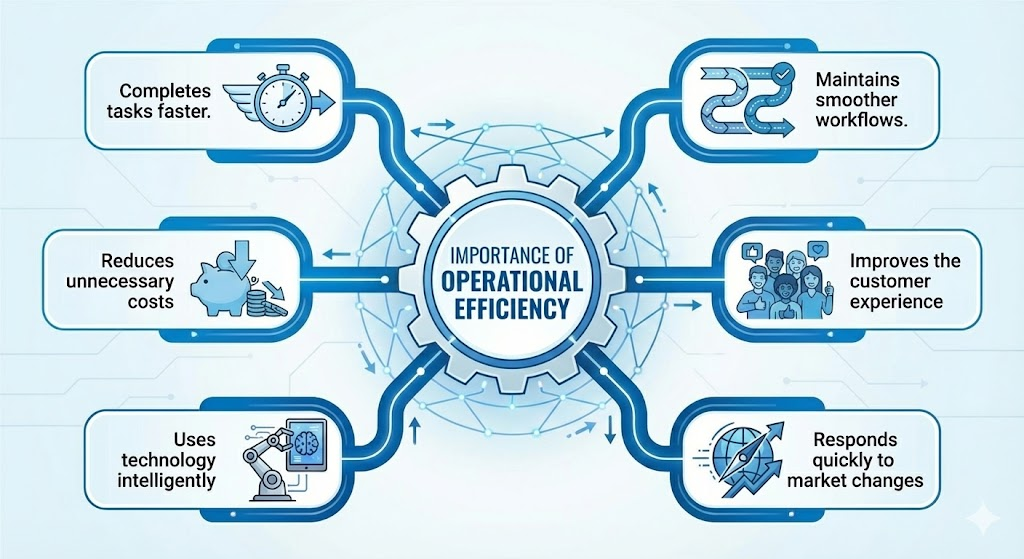
An efficient business:
- Completes tasks faster.
- Maintains smoother workflows.
- Reduces unnecessary costs.
- Improves the customer experience.
- Uses technology intelligently.
- Responds quickly to market changes.
Think of it as upgrading an old, slow engine to a smart, streamlined version. It’s not only faster; it’s more consistent, reliable, and requires far less effort to maintain.
The Need for Operational Efficiency When Scaling
1. It Reduces Costs Dramatically Efficiency reduces waste such as manual errors, rejections, unnecessary raw material consumption, and suboptimal equipment usage. Companies that optimize their operations can often cut costs by 20–40%.
2. It Boosts Productivity Without Over-Hiring Rather than hiring more people the moment a workload grows, lean companies utilize systems and efficient workflows. This allows firms to scale operations without their payroll expenses spiraling out of control.
3. It Improves Customer Satisfaction Faster service, fewer errors, and better communication translate directly to customer loyalty and a stronger brand reputation.
4. It enables Agility Markets to change fast. Lean operations make businesses flexible enough to pivot and adapt to market shifts without organizational trauma.
5. It Increases Profit Margins The equation is simple: Reduced costs + higher productivity + greater consistency = healthy profitability.
Factors That Affect Operational Efficiency
Efficiency is rarely the result of luck; it depends on several key pillars:
- Workflow Design: Poor processes create bottlenecks, confusion, and duplication of effort.
- Technology and Automation: Outdated tools slow down production. Modern automation systems create streamlined, error-free processes.
- Employee Skills and Training: The finest systems will fail if the people operating them aren’t properly trained.
- Communication and Collaboration: When information moves seamlessly between departments, teams work faster and with fewer errors.
- Resource Utilization: Successful businesses maximize the utility of their time, staff, machinery, and capital.
- Data and Performance Tracking: Without accurate data, businesses are “flying blind.” Monitoring KPIs helps identify what is working and what needs improvement.
- Company Culture: A culture of performance, discipline, and accountability naturally raises collective efficiency.
How to Increase Operational Efficiency (Practical Steps)
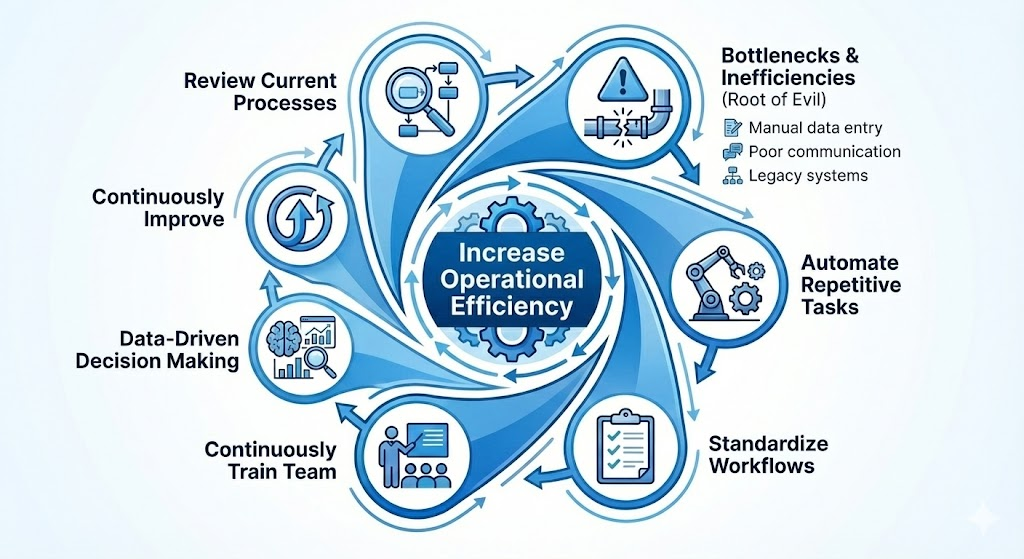
Step 1: Review Your Current Processes Map out every step of your current workflow. Identify where delays occur, where work is being repeated, and where customers experience friction.
Step 2: Eliminate Bottlenecks Common bottlenecks include manual data entry, slow approval hierarchies, inventory mismanagement, and obsolete software. Fixing even one major bottleneck can save dozens of hours a week.
Step 3: Automate Repetitive Tasks Automation minimizes human error and quickens action. It is one of the fastest ways to scale an operation sustainably.
Step 4: Standardize Workflows Document your processes clearly. When a team follows a standardized “playbook,” quality remains consistent and confusion disappears.
Step 5: Continuously Train Your Team Efficiency follows expertise. Ensure your team knows how to use your systems and tools to their full potential.
Step 6: Data-Driven Decision Making Track key metrics such as turnaround time, cost per task, and error rates. Data exposes hidden inefficiencies, allowing for objective decision-making.
Step 7: Commit to Continuous Improvement Efficiency is a journey, not a destination. Regularly audit your processes and make incremental improvements frequently.
Case Studies: Efficiency in Action
- Amazon: By integrating robotics across fulfillment centers, Amazon reduced operating costs by 20% and increased order processing speeds to just 15 minutes.
- Zara: Zara built a hyper-efficient supply chain that moves designs to store shelves in just 15 days, significantly lowering inventory waste.
- DHL: Using AI for route optimization, DHL cut fuel costs by 15% and improved delivery speeds by 25%.
How Touchdown Strategy Can Help
Scaling a business is complex, but you don’t have to do it alone. Touchdown Strategy specializes in helping companies make their workflows seamless and their growth predictable.
Rather than offering cookie-cutter templates, we design custom solutions tailored to your industry, size, and growth ambitions. We help companies:
- Redesign workflows for maximum output.
- Implement automation across Sales, Finance, HR, and Operations.
- Establish KPIs and performance tracking tools.
- Ensure smooth team transitions during system upgrades.
Companies using the Touchdown Strategy see less overhead, better scalability, and more predictable performance.
Learn more at: touchdownstrategy.com
Conclusion
Operational efficiency is the lifeblood of growth. It allows you to expand without anxiety, save money, and keep customers happy. By streamlining processes and embracing automation, any business—regardless of size—can stay relevant and profitable in a changing market.